
Cristina Acidini about Slavko Kopac
An Exhibition to Remember
Kopac’s works never fail to make a profound impression, whether on first viewing or upon their rediscovery after years as lingering memories. The artist’s distinct sensibility – whether as painter, sculptor, or calligrapher – traverses the eras of human creativity and captures its protean forms, stretching backward into antiquity and ultimately musing on the primordial origins of images themselves, embodied in Palaeolithic cave drawings and paintings such as those discovered in Lascaux in 1940.
Though it would be a mistake to label Kopac’s work Art Brut, it’s no surprise that he should have admired such art, nor that – particularly as the first custodian of the Collection bearing its name – he should have championed it from within the Compagnie de l’Art Brut. Kopac’s aesthetic – and psychological – inquiries, conducted during a period profoundly influenced by those pathways to human intro spection charted by Sigmund Freud and Carl Gustav Jung, led to his creation of elemental and absolute forms that, enlivened by an explosive richness and variety of materials, engage in a constant dialogue with poetry. The artist’s immersion in the artistic and literary worlds of France is borne out in his original and personal vein of Surrealism, which transforms natural data into allusive and potent signs.
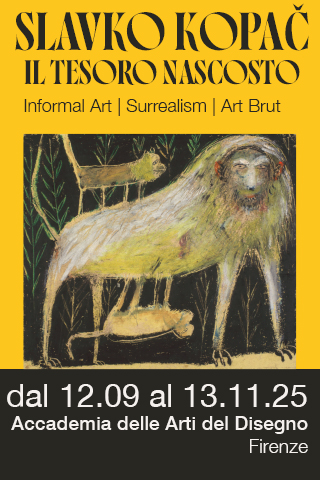
Poster for the exhibition Slavko Kopac: The Hidden Treasure. Informal Art, Surrealism, Art Brut. Florence, 2025
From the book accompanying the exhibition Slavko Kopac: The Hidden Treasure. Informal Art, Surrealism, Art Brut. 5 Continents Editions, Milan, 2025
Read the full essay in the book available at the link provided below: