
Gilles Plazy about Slavko Kopac

Shipwreck, 1947/48
Slavko Kopac must have encountered some kind of god on his path during childhood. I can imagine him playing in the pebbles of summer at a distance from his playmates – daydreaming no doubt – not exactly lost but straying somewhere for a while, no longer finding the way and being obliged to discover a new path. And here he encounters a god. Do not laugh, these things happen. At least to children who know not to wear blinders. It was a young god, too luminous for the child to see his traits. Yes, a young and radiant god who appeared on his path and called to him.
“Hello Slavko, I am here to give you a gift. What would you like?”
“Tell me the way home.”
“Go before you at your desire and do not search for your house. Your house is anywhere that you want and when you want. I offer you these soles of wind, they will permit you to always return home, whenever you want.”
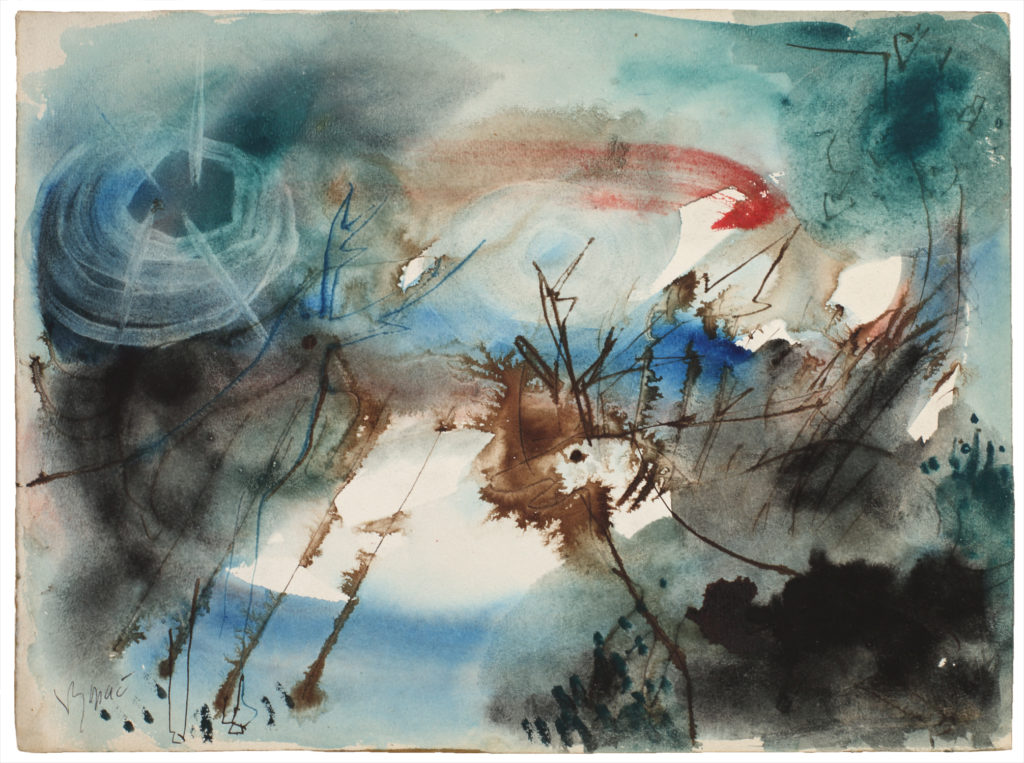
Deer at watespring, 1947/48
Since then Slavko always wears his soles of wind. Also, wherever he is, he is always at home. This is what gives his work, four decades long, its familiar tone, its apparent spontaneity, its freshness, its smiling naïvety, its optimistic fantasy, its poetic sensibility, its gracious imagination…
It is not easy to give him an epithet. Naïve? He does not have this application for minute detail which is generally attributed to the naïve painters. Primitive? Yes, if we allude to this first movement which he continues to have confidence in, but this word is also too ambiguous. Brut? Yes, by allusion to this art brut which with his friend Dubuffet he was the principal initiator in constituting the famous collection now in Lausanne.
The problem is that the form of art we are concerned with and which more or less designates the three preceding terms is generally the work of rough, wild, or even people on the verge of a nervous breakdown who cultivate their strange genius in private. Kopac is not like that. Surely because of the god that had given him the gift of lightness. Surely he is on the side of this strange art which he breathes but in his own manner – and this is a particular quality in his way of holding himself at the edge of dreams without losing himself within.
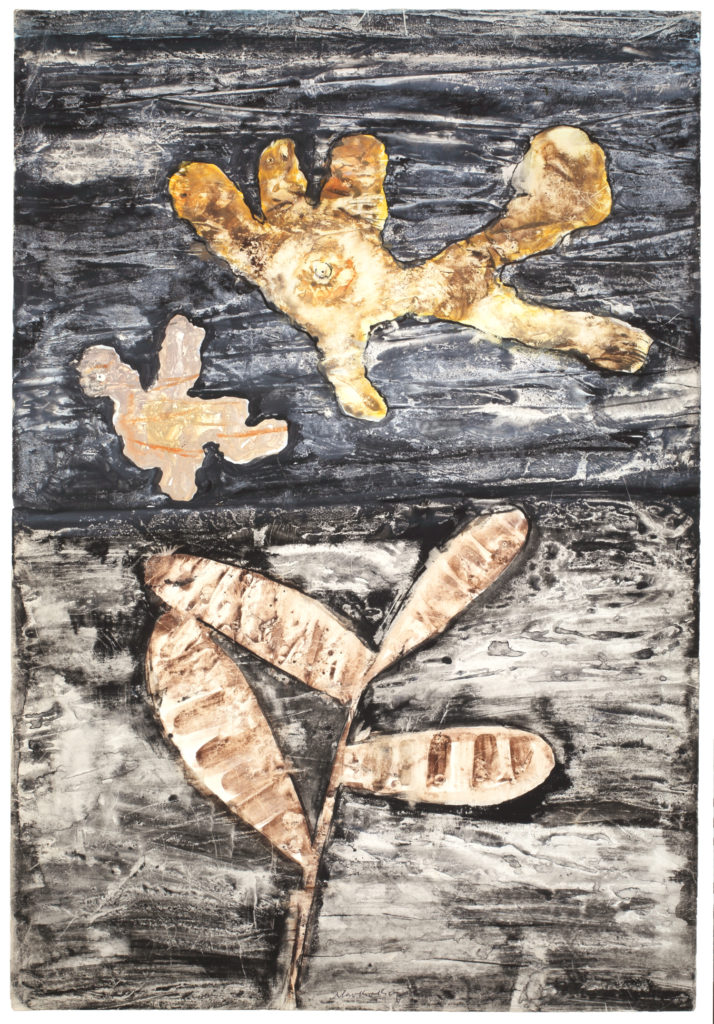
Tree + birds, 1964
D’ailleurs Kopac a fait un rêve, un jour, (mais était-ce bien un rêve?). Il faisait l’école buissonnière dans les collines caillouteuses et comme il avait marché sous le soleil il s’assit sur un rocher pour se reposer. Il regarda quelques instants les moutons qui, à mi-pente, tentaient de trouver quelques herbes sèches et c’est soudain qu’il vit devant lui, sans même l’avoir senti approcher, le Berger à la Barbe Verte.
Celui-ci souriait et le regardait sans rien dire. Kopac sourit aussi mais ne dit rien. Le Berger prit alors le bâton sur lequel il s’appuyait et le porta à sa bouche. C’était une flûte et il joua un air limpide, clair, aérien, lumineux. Puis il disparut comme il était venu. Une source maintenant coulait là où il s’était tenu. Kopac but de cette eau et, tout revigoré, monta plus haut dans la montagne. Comme la nuit tombait, il trouva une cabane et y passa la nuit. Les murs étaient blancs et il n’avait pas sommeil. La lune était assez claire et il couvrit les murs de dessins qu’il fit avec les charbons du foyer.
Plus tard, adulte, chaussé de ses semelles de vent, il tenta de retrouver dans la montagne cette cabane mais personne n’en avait entendu parler. Non plus que du Berger à la Barbe Verte. Mais nous, n’est-ce pas, nous savons qu’ils existent, puisque Kopač existe.
Kopac existe avec ses mains légères d’où sortent comme des bulles joyeuses des dessins, des peintures, des collages, des sculptures; chacune de ses œuvres est une apparition inattendue, l’éveil d’un être original sur la paroi d’un mur… Telle est ici la pureté de la vie même.

Oak, 1985